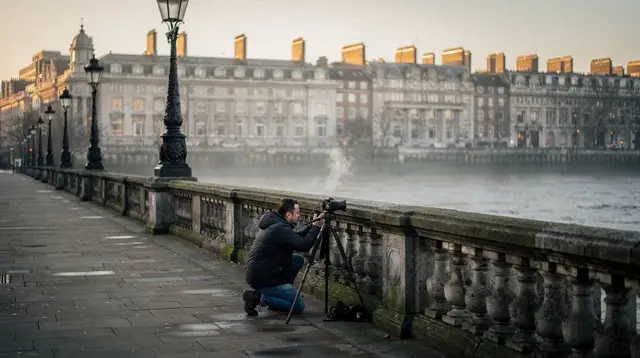
Walking the river from Westminster Bridge to Tower Bridge
South Bank is not a single sight but a two-and-a-half kilometre stretch of the Thames’s south bank, running roughly from Westminster Bridge to Tower Bridge. It sits directly across the river from Westminster and the City, and that facing position is the whole point: most of what people come here for is the view back across the water, plus a cluster of specific attractions strung along the promenade.
Walked end to end at an easy pace, the riverside path takes about an hour without stopping. Almost nobody does it without stopping. Realistically, allow half a day if you want to see the London Eye area, walk past Shakespeare’s Globe and Tate Modern, and spend proper time at Borough Market. A full day lets you add a paid attraction and a sit-down meal.
The path itself is flat, well signed and free to walk at any hour. That’s worth saying plainly, because a first-time visitor could easily assume South Bank is one paid attraction — it isn’t. The London Eye is paid. The riverside walk, the views of the Palace of Westminster and the City skyline, and access to the outside of Shakespeare’s Globe and Tate Modern cost nothing.
London Eye: what it actually is, and what it costs
The London Eye is a 135-metre observation wheel next to Westminster Bridge, on the South Bank side. A rotation takes about 30 minutes, in enclosed glass capsules, and tickets are date- and time-slotted — you book a specific entry window, not a walk-up queue.
Standard tickets run roughly £30-£45 per adult depending on the date and how far ahead you book, with “fast track” and combination options costing more. Prices shift by season and demand, so treat any figure here as a guide and check the current price on the day you plan to visit. Booking ahead matters more than it sounds: same-day walk-up availability in summer is unreliable, and the ticket office queue alone can eat 30-45 minutes.
a combined walking tour of London’s top 20 sights with a timed London Eye ride is a practical way to fix your Eye slot around a wider sightseeing walk rather than treating the wheel as a stand-alone errand. For a shorter, cheaper river-view alternative, a river cruise ticket paired with London Eye entry adds a Thames boat leg to the same visit.
Whether the London Eye is worth the price for your trip is a genuinely mixed call — see our honest verdict on the London Eye before you book, especially if budget is tight.
The free alternative: skip the wheel, keep the view
The view from inside a London Eye capsule is panoramic and does show the whole city at once, which street level can’t. But if budget or time is short, the free views from the South Bank promenade itself — and from the middle of the Millennium Bridge, looking at St Paul’s Cathedral on one side and Tate Modern on the other — cover most of the same ground at zero cost and with no time slot to book around. The Golden Jubilee footbridges next to Hungerford Bridge are another free vantage point, with a clean line down the river towards the Palace of Westminster. For more paid and free options across the city, see our guide to London’s best views.
Tate Modern and the Millennium Bridge
Tate Modern occupies the former Bankside Power Station, a short walk east of the London Eye along the river. It is one of the UK’s national museums, which means its permanent collection is free to enter — the same rule that applies to the British Museum and the museums of Kensington and Chelsea. Only ticketed special exhibitions carry a charge, typically £15-£22.
The Millennium Bridge, a slim pedestrian footbridge, connects Tate Modern directly to St Paul’s Cathedral on the north bank. Crossing it takes a few minutes and gives one of the cleaner photo compositions in London: St Paul’s dome framed by the bridge’s cables. It’s free, open at all hours, and gets busy at sunset.
Shakespeare’s Globe
A short walk further along from Tate Modern, Shakespeare’s Globe is a reconstruction of the open-air Elizabethan theatre where Shakespeare’s company performed, built close to the original site. It runs a seasonal programme of plays (broadly April to October, since the main yard is open to the sky) and year-round exhibition tours. Standing-yard tickets for performances are the cheapest way in, from around £10-£25, though you’ll be on your feet in the open for the whole show — check the forecast, because London’s weather is changeable and there’s no promise of a dry evening even in July. For a wider look at London’s stage options, our West End theatre guide and theatre tickets advice cover booking further ahead.
Borough Market
Borough Market sits just south of London Bridge station, a few minutes’ walk inland from the river path near Southwark Cathedral. It’s one of London’s oldest food markets, dense with stalls selling everything from cheese and charcuterie to hot street food, and it gets genuinely crowded at lunchtime on weekdays and through the weekend.
Weekday mornings before 11am are the calmest time to browse without queuing for every stall. If you want context rather than just grazing, a guided food walk covers more ground and explains what you’re eating: a Southwark and Bankside food tour built around Borough Market or, for a wider sweep of London’s markets including one further east, a food tour covering three London markets from South Bank to Brick Lane. For a self-guided approach, our South Bank food and drink guide lists specific stalls worth the queue.
The Shard
The Shard, London’s tallest building, stands just south of London Bridge station, technically on the edge of South Bank rather than on the riverside path itself. Its viewing platform, The View from The Shard, sits on floors 68-72 and gives a higher, more distant vantage point than the London Eye — Central London spread out below rather than the river up close. Tickets run roughly £30-£40 for standard slots, again date- and time-stamped like the Eye.
a top-20-sights walking tour paired with Shard entry bundles the climb with a guided walk of the surrounding sights, which is a reasonable way to justify the ticket price if you’d otherwise only spend 45 minutes at the top.
Other things along the way
The path also passes the Southbank Centre and National Theatre (a cultural complex worth a glance even if you’re not seeing a show), the London Dungeon and Sea Life London Aquarium near County Hall (both aimed squarely at families and younger children), and HMS Belfast, a preserved Second World War cruiser moored near Tower Bridge that’s paid to board.
For accommodation nearby, our where to stay in London guide covers South Bank hotels against the alternative of basing yourself in the West End or Bloomsbury instead.
South Bank at a glance
| Attraction | Cost | Typical time needed | Booking |
|---|---|---|---|
| Riverside walk | Free | 45-90 min | Not needed |
| London Eye | £30-£45 | 30 min ride, plus queue | Timed ticket recommended |
| Millennium Bridge view | Free | 5-10 min | Not needed |
| Tate Modern (permanent collection) | Free | 1-2 hours | Not needed |
| Shakespeare’s Globe (exhibition tour) | £15-£20 | 45 min | Recommended in season |
| Borough Market | Free to browse | 1-2 hours | Not needed |
| The Shard viewing platform | £30-£40 | 45-60 min, plus queue | Timed ticket required |
Prices above are broad ranges, not fixed figures — always check the exact fare on the booking page for your date before you commit.
Getting there and getting around
South Bank is served by several Tube and rail stations rather than one hub: Waterloo (also a mainline station for trains from the south-west of England), Southwark, London Bridge and Embankment (on the north bank, across Hungerford Bridge) all sit within walking distance of different parts of the promenade. Waterloo is the busiest and most central for the London Eye end. There’s no need for a car, and given that driving in the UK means keeping to the left, a car adds nothing to a visit here anyway.
An Oyster or contactless card covers every Tube, bus or river-boat leg you’ll need, with fares capped automatically for the day — see our Oyster vs contactless comparison if you’re arriving without either. A Thames Clippers river boat is also a legitimate way to arrive, stopping close to the London Eye and near Tower Bridge, and it doubles as a low-cost river view in its own right; see our Thames cruises guide for routes and prices.
When to visit
South Bank works at any time of year, but a few timing points are worth knowing. Weekday mornings are quietest at Borough Market and for London Eye queues; weekends bring the biggest crowds to the whole stretch. Evenings around sunset are the best light for photos from the Millennium Bridge and the promenade near the Eye, and in winter this falls as early as 4pm. As with the rest of London, expect changeable weather rather than a reliably clear sky even in midsummer — see our best time to visit London guide for month-by-month detail.
The area is also close enough to Tower Bridge and the City to combine into a single day, particularly if you’re already planning to see the Tower of London — the walk between the two takes about 20-25 minutes along the river.
South Bank questions: London Eye, Tate Modern and Borough Market
Is the London Eye worth the price?
It depends on your budget and what you want from the view. It’s the only spot on South Bank that puts you 135 metres up with a 360-degree panorama, but the same river and skyline are visible for free from the promenade and the Millennium Bridge at street level. See our full London Eye verdict for a longer answer.
Are Tate Modern and Borough Market free?
Tate Modern’s permanent collection is free, as with all UK national museums; only special ticketed exhibitions cost money, typically £15-£22. Borough Market is free to enter and browse — you only pay for what you eat or buy.
How long does the South Bank walk take?
Walked without stopping, the promenade from Westminster Bridge to Tower Bridge takes 45-90 minutes. With stops at Tate Modern, Shakespeare’s Globe and Borough Market, allow half a day; add a paid attraction like the London Eye or the Shard and it’s a full day.
Which station is best for South Bank?
Waterloo is the most central for the London Eye and the western end of the walk. Southwark and London Bridge sit closer to Tate Modern, Shakespeare’s Globe, Borough Market and the Shard.
Can I see South Bank and the Tower of London in one day?
Yes — the walk between Tower Bridge and the Tower of London on the north bank takes about 20-25 minutes, so combining South Bank with a Tower of London morning is a realistic single day. Book the Tower of London slot first, since it’s the more time-pressured ticket.
Do I need to book the London Eye and the Shard in advance?
Booking ahead is strongly recommended for both. Tickets are date- and time-slotted, and same-day walk-up availability is unreliable in peak season (roughly June to August and around Christmas), with queues at the ticket office alone running 30-45 minutes.
Is South Bank suitable for a rainy day?
Partly. Tate Modern, Shakespeare’s Globe’s exhibition (not performances, which are largely outdoor and seasonal), Borough Market’s covered sections and the London Eye’s enclosed capsules all work in wet weather. The riverside walk itself is exposed, so pack a light waterproof rather than relying on umbrellas in the wind off the Thames.
What’s the cheapest way to enjoy South Bank?
Walk the promenade, cross the Millennium Bridge, browse Borough Market and see Tate Modern’s permanent collection — all free. That covers the core of South Bank’s appeal; the London Eye and the Shard are the optional paid add-ons on top.