Walking tours of London: routes that actually work on foot
What is the best way to plan a walking tour of London?
Pick one neighbourhood cluster rather than trying to cross the whole city on foot. A comfortable half-day walk covers 5 to 8 kilometres and 3 to 4 hours with stops; anything linking Westminster to Greenwich or Camden to the City is better split with the Tube or the river.
Why most London walking plans fail before lunch
The mistake we see most often is a route that treats London like a single compact old town. It isn’t. London is a collection of neighbourhoods that grew up separately and only later got stitched together by the Tube, the Overground and the river. A walk that tries to link Westminster, Camden and Greenwich in one afternoon on foot will burn a full day on pavement alone, with none of it spent actually looking at anything.
This guide gives you realistic distances and times, tells you which stretches of London are genuinely pleasant to walk — as opposed to merely famous — and points you to the neighbourhood-level guides for turn-by-turn detail. Think of this as the map-reading layer: the specific stops, opening hours and step-by-step routes live in the destination and things-to-do pages linked throughout.
Distance and time, not just distance
A kilometre in the City with dense pavements and traffic lights takes longer than a kilometre along the South Bank riverside path. Budget time, not just distance, and add 15 to 20 minutes per hour for photo stops, crossing roads and the inevitable queue for a toilet or a coffee.
| Walk | Distance | Walking time | Realistic half-day time |
|---|---|---|---|
| Tower of London to Westminster along the river | ~5 km | 70–90 min | 3–4 hours with stops |
| Bloomsbury to the West End | ~2 km | 25–30 min | 1.5–2 hours with a museum stop |
| South Bank, Tower Bridge to the London Eye | ~4 km | 50–60 min | 2.5–3 hours |
| Greenwich town centre to the park and observatory | ~2.5 km | 30–35 min | 2 hours with the observatory |
| Camden Lock to Regent’s Park | ~2 km | 25 min | 1.5 hours |
| Richmond towpath to Kew Gardens | ~5 km | 60–70 min | half a day with the gardens |
Anything longer than about 8 kilometres in one stretch is a full walking day for most people, not a stroll between sights.
Not every stretch of this network is step-free or pushchair-friendly. The older lanes around the Tower of London and the City still have sections of cobbled paving that catch narrow wheels and turn slick after rain. The South Bank riverside path itself is flat and fully accessible, but several of the connecting bridges and the elevated walkway on Tower Bridge are not step-free at every entrance, so it’s worth checking the specific crossing rather than assuming the whole cluster is uniform. The Richmond and Kew towpath is the most consistently accessible long stretch on this list — flat, wide gravel rather than kerbs and crossings — though it can turn muddy after heavy rain.
Neighbourhood clusters that work on foot
London rewards walking within a cluster and using the Tube, Overground or river between clusters. Trying to walk between clusters is the single biggest cause of a disappointing day.
Westminster, South Bank and the City — the river cluster
This is the one continuous stretch of London where walking genuinely beats every other option, because the Tower of London and the City, South Bank and Westminster all sit along the same bank or face each other across the same short stretch of river. The path is flat, well signed and rarely more than a few hundred metres from a Tube station if you need to bail out. It is also the most crowded stretch in the city, especially between Tower Bridge and the London Eye on a weekend afternoon — plan for slower progress than the raw distance suggests, or walk it early morning instead.
Bloomsbury and the West End — short, dense, indoor-heavy
Bloomsbury and the West End sit close enough together that the walking itself is almost incidental; the time goes into what’s inside — the British Museum, Covent Garden’s shops, a theatre matinee. Good for a rainy day, since most of the actual time is spent indoors.
Camden and Regent’s Park — a shorter, calmer alternative to the centre
Camden to Regent’s Park via the canal towpath is a genuinely pleasant short walk, quieter than the market itself once you’re past the lock, with the canal doing a lot of the scenic work.
Richmond, Kew and the towpath — the long, quiet option
The Richmond and Kew stretch of the Thames towpath is the closest London gets to open countryside walking without leaving the city. It’s a longer commitment — the towpath itself runs several kilometres — but it’s flat, well shaded and far less crowded than anything in central London, even on a warm weekend.
East London and Greenwich — walkable in pieces, not as one route
East London and Greenwich each work well as a self-contained half-day walk, but they are not close enough to link on foot with each other or with central London — the DLR or Overground is the sensible connector, not a march along the river.
If you only have one half-day for walking
Choosing between the river cluster and a quieter alternative comes down to what you’d rather trade. The river cluster between Westminster and the Tower delivers the highest density of recognisable sights per kilometre walked, but you’ll be sharing the path with the largest crowds in London and moving slower than the distance suggests. Richmond and Kew trade that density for space and quiet, at the cost of a longer round trip from central London and fewer named landmarks along the way.
Camden to Regent’s Park sits between the two: shorter and calmer than the river cluster, but with far less to see once you’re past the market and the zoo perimeter. If this is your only full day in London and you’ve never seen Big Ben or Tower Bridge in person, the river cluster wins despite the crowds — the quieter walks are a better fit for a second or third visit, or for a traveller who has already covered the landmarks on an earlier trip.
Where to walk if you want fewer crowds
If the goal is a genuinely pleasant walk rather than a checklist of famous names, the honest picture looks different from the postcard version of London:
- Richmond and Kew — the quietest stretch on this list, especially on weekday mornings, and the one closest to feeling like open country.
- Greenwich Park, away from the observatory steps at midday — the wider park has real space to spread out.
- Weekday mornings in South Bank, before the lunchtime and evening crowds build along the riverside path.
- East London side streets off the main Brick Lane and Columbia Road stretches, once the Sunday market crowds have moved on.
What the postcard doesn’t show is how much of the South Bank riverside path is lined with buskers, competing sound systems and pop-up stalls for most of its length between the London Eye and Tower Bridge — pleasant in small doses, tiring over a full afternoon, and considerably louder than most first-time visitors expect from a “riverside walk.” Anyone picturing a quiet stroll by the water should treat South Bank as a lively street rather than a park path, and save the genuinely calm river walking for Richmond or the quieter stretch of towpath past Kew.
Westminster and the West End are worth walking for what’s there, but neither is a “quiet walk” at any time of day — plan your expectations around history and sightlines, not solitude.
Guided walks versus self-guided routes
A self-guided route works well for the river cluster and for Bloomsbury–West End, both of which are short, well signposted and safe to navigate with a phone map. A guided walk earns its price where context matters more than navigation: ghost stories in the City’s older lanes, film locations that aren’t marked with any signage, or a themed route through royal London that links buildings you’d otherwise walk straight past.
a guided walk along the Thames riverside path covers the busiest and most photogenic stretch of the river cluster with someone who can point out what’s easy to miss between Tower Bridge and Westminster.
For a route built around the buildings rather than the river, a walking tour focused on royal London links Buckingham Palace, St James’s and Westminster with the history that a self-guided walk would need a guidebook open on your phone to piece together.
If your time is tight and you’d rather have a route shaped around what you actually want to see, a bespoke walking tour of central London can be built around a specific mix of neighbourhoods rather than a fixed itinerary.
Themed walks worth planning around
Beyond the geography, several themed walks are popular enough in London to be worth booking rather than assembling yourself:
- Film and TV locations — routes built around where specific scenes were shot, mostly in central London and East London.
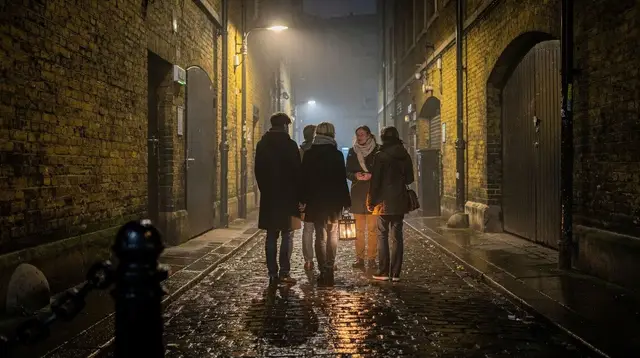
- Ghost and crime history — evening walks through the City’s older, narrower streets, where the atmosphere depends on going after dark.
- Music history — walks tracing specific bands or eras through Soho and the West End.
- Food-focused walks — shorter routes built around tastings rather than distance covered.
These work better as a booked activity than a self-guided attempt, since the value is in the stories and access, not the walking itself.
Practical notes for walking in London
Pavements and crossings. Central London’s pavements are generally good, but narrow lanes in the City and parts of Bloomsbury get congested at peak times. Crossings are well marked; remember that traffic in the UK drives on the left, which changes which way to look first.
Weather. London’s climate is temperate and changeable rather than reliably wet or dry by season — expect cloud cover even in summer, and carry a light waterproof rather than betting on a forecast holding for a whole day.
Water and toilets. Tap water is safe to drink everywhere, and most museums along the river cluster route are free to enter, which also solves the toilet-stop problem on longer walks.
Getting back. Every cluster in this guide sits within a short walk of a Tube, Overground, DLR or riverboat stop, so a walk that’s running long or a foot that’s had enough is rarely more than 10–15 minutes from a way home.
Fitting a walk into a longer visit
A single walking day works well slotted into a broader London itinerary rather than as the entire plan — one river-cluster morning, one quieter afternoon in Richmond or Greenwich, with everything else covered by public transport. For the mechanics of moving between neighbourhoods when you’re not walking, see getting around London by Tube, bus and boat. For the view from above rather than street level, the best viewpoints across London pairs well with a walking day, and a Thames river cruise covers the same riverside stretch from the water on a day when your feet need a rest.
If ghost stories and darker history appealed above, the fuller route detail is in the ghost and crime tours guide; for film locations, see the Harry Potter locations guide, which doubles as a walking route through several central neighbourhoods.
a film-locations walking tour and an evening ghost walk through the City’s older streets both work as a themed alternative to a self-guided route, particularly after dark when navigating the smaller lanes alone is less appealing.
For neighbourhood-level detail beyond what fits here, start with things to do in South Bank, things to do in the West End, things to do in Bloomsbury, things to do in Camden and things to do in Greenwich, each of which breaks its cluster down stop by stop.
Walking tour FAQ for London
How far can you realistically walk in London in one day?
Most visitors comfortably manage 10 to 14 kilometres across a full day when the route includes stops for food, museums and photos. Beyond that, feet and patience both give out faster than the map suggests.
Is central London walkable without a guided tour?
Yes. Westminster, South Bank, the West End and Bloomsbury are close enough to link on foot with a paper or phone map, and pavements are well maintained. A guide adds context and history rather than being necessary for navigation.
Which part of London is best for a quiet, unhurried walk?
Richmond, Greenwich and parts of East London away from Brick Lane’s peak hours offer more space and fewer crowds than Westminster or the South Bank riverside path, especially on weekday mornings.
Do I need to book a walking tour in advance?
Small-group and themed walks such as ghost tours or film-location walks fill up on weekend evenings and around school holidays, so booking a day or two ahead is safer than turning up.
Can you walk from the Tower of London to Westminster?
Yes, it is roughly 5 kilometres along the river through the City and past South Bank, taking about 70 to 90 minutes without stops, longer with any museum or bridge photo stops.
Is it better to walk or take the Tube between London’s main sights?
Within one cluster — Westminster to South Bank, or Bloomsbury to the West End — walking is usually faster once you count queuing for the Tube. Between distant clusters, such as Greenwich to Camden, the Tube or riverboat is faster and less tiring.
Are London’s walking tours suitable for children?
Shorter themed walks under 90 minutes generally work for children aged 8 and up; full-day self-guided routes are demanding for younger children and better split across two shorter outings.
Are London’s walking routes accessible for wheelchairs and pushchairs?
The South Bank riverside path and the Richmond-Kew towpath are the most consistently flat and step-free options on this list. The older lanes around the City and Tower Bridge’s elevated walkway include cobbles and steps at some entrances, so check the specific crossing rather than assuming a whole cluster is uniform.
What time should a walk start to avoid the worst crowds?
Starting before 9am makes the biggest difference on the river cluster and South Bank, both of which fill up by mid-morning and stay busy until early evening. Richmond, Kew and Greenwich Park stay calmer for longer, so a later start there costs less.
Guided walking tours of London on GetYourGuide
Verified deep-linked GetYourGuide tours. Book through these links and we earn a small commission at no cost to you.
GetYourGuide does not provide a product photo for this activity — the image shows the meeting point, photographed by us.