London food and drink tours: markets, pubs and where not to eat
What's the best way to try London's food and drink scene without overpaying?
Stick to food markets (Borough, Camden, Brick Lane) for variety at fair prices, and check restaurant bills for a service charge before tipping extra. Skip the generic cafes right outside major sights like the Tower of London or Buckingham Palace — walk two streets away for better food and lower prices.
London’s food scene runs from Michelin dining to market stalls selling a bowl of noodles for a few pounds, and the gap between a good meal and an overpriced one is often just a couple of streets. This guide covers where to eat well, where the tourist traps sit, and how tipping actually works — at a citywide level, pointing to neighbourhood guides for the detail on each area.
Food markets worth the trip
Markets are the easiest way to eat a variety of good food without committing to a sit-down restaurant, and they work for lunch, dinner or grazing between sights.
Borough Market (near South Bank) is London’s best-known food market, with fixed produce stalls alongside street food vendors selling everything from Ethiopian stews to fresh oysters. It gets busy at lunchtime on weekdays and very busy on Saturdays — arrive before midday or after 2pm for shorter queues. It sits a short walk from the Globe and Tate Modern, so it pairs easily with a South Bank morning.
Camden Market combines food stalls with clothing and craft stands along Camden’s canal. Food quality is more mixed here than at Borough — some stalls are genuinely good, others cater purely to passing tourist traffic — so check what looks freshly cooked rather than sitting under a heat lamp.
Brick Lane in East London is known for bagels (24-hour bakeries), curry houses along the strip, and a Sunday street food market that draws a young, local crowd as much as tourists.
Smaller neighbourhood markets — Broadway Market in East London, Maltby Street near Borough — get less foot traffic and often better prices for similar quality. For the full list by area, see the London food markets and food tours guide.
Market days matter more than most first-time visitors expect. Borough Market runs its full stall lineup from Wednesday through Saturday; earlier in the week, several traders don’t open at all, so a Monday or Tuesday visit can mean half the stalls are shuttered even though the market itself is technically open. Check the market’s own listing the morning of a weekday visit rather than assuming every stall trades every day. Brick Lane’s street food market is a weekend fixture, mainly Sunday, so a weekday walk down the same street finds the bakeries and curry houses open but the outdoor stalls gone. Camden Market trades daily, which makes it the more reliable fallback if you’re food-market-hunting midweek and Borough is running thin.
Market food also runs seasonally in a way sit-down restaurants don’t. Summer brings longer queues and more stalls trading outdoors; in winter, some outdoor pitches close early as light fades by mid-afternoon, and a market visit is better scheduled for late morning rather than pushed to 4pm. None of the big three markets are heavily covered end to end, so a wet day changes the experience — Borough Market has more covered sections than Camden or Brick Lane, which makes it the steadier choice if rain is forecast.
If you only have one food stop
With limited time, it’s worth being honest about which single food experience earns a slot on the itinerary rather than trying to fit in all three. Borough Market wins for food quality and variety per minute spent — it’s the most reliable pick if you’re only doing one market and want to actually eat well rather than just look around.
Brick Lane wins if the goal is atmosphere and a sense of a working London neighbourhood rather than a curated food experience; it reads more like a local street on a Sunday than a tourist stop, which is part of its appeal and part of why the food quality is more uneven. Camden Market is the weakest of the three purely on food, and makes more sense as a stop for the market and canal walk itself, with food as a secondary reason to go. If a schedule only allows a single stop and food is the priority, Borough Market is the honest recommendation over the other two.
Historic pubs and how to use them
The pub is a genuine piece of London social life, not just a tourist activity, and that shapes how they run. Most pubs serve food during set kitchen hours — typically lunch until mid-afternoon, then dinner from around 6pm — and kitchens can close between those windows even if the bar stays open.
Historic pubs cluster in the City and Westminster, some dating back centuries and rebuilt after the Great Fire or the Blitz. These get genuinely crowded with office workers from around 5:30pm on weekdays, standing room only at the bar — arrive by 5pm or after 8pm if you want a table.
Ordering works differently from many countries: you order and pay at the bar, not from table service, and you carry your own drinks back. Tipping bar staff for drinks isn’t expected, though a small tip is fine if you’ve had table service for food.
For a guided route through several pubs and their history, a pub crawl or history-themed drinks tour covers ground faster than working it out alone — the Central London pub crawl with drink deals links several venues with discounted rounds, and the history of London told through four drinks pairs pub stops with historical context. For neighbourhood detail, see the London pub culture guide.
Historic pubs are rarely built with step-free access or reduced-mobility visitors in mind: narrow doorways, steps down to cellar bars and standing-room-only floors at peak times are common in centuries-old buildings. If accessibility matters, calling ahead or checking a pub’s own site for step-free entry is worth doing before planning an evening around one specific address, since the atmosphere that makes these pubs worth visiting is often tied to the cramped, historic layout that makes them hard to adapt.
Card payment is now standard at nearly every pub in central London, including for a single drink at the bar, so carrying cash purely for pub rounds isn’t necessary the way it once was. A few smaller, older pubs still prefer card over contactless for split rounds above the contactless limit, but outright cash-only pubs are now rare in the areas covered by this guide.
Where the tourist traps are
The pattern repeats across London: cafes and pubs directly facing a major sight tend to charge more for food that’s no better — sometimes worse — than options a five-minute walk away.
| Location | What to watch for | Better move |
|---|---|---|
| Around the Tower of London | Set-menu cafes at inflated prices | Walk into the City for lunch options |
| Facing Buckingham Palace | Tourist-menu pubs and cafes on the main routes | Head toward Westminster side streets |
| Leicester Square | Chain restaurants with tourist pricing | West End streets just north or east |
| Outside Westminster Abbey | Limited, pricier lunch spots | Cross toward South Bank via the bridge |
| Camden Market food stalls | Uneven quality, some purely for passing trade | Look for stalls with a visible queue of locals |
This isn’t unique to London — it’s true of any city near its landmarks — but the density of major sights within Central London makes it worth planning around, rather than eating at the first place you see after a queue for the Tower of London or the London Eye.
The disappointment isn’t always about price — it’s often about portion and prep quality dropping while the price stays at a “sightseeing” premium. A sandwich or a full English breakfast facing a major landmark can look identical to one two streets away but arrive pre-made, reheated or thinner on filling, because the venue’s turnover comes from one-time visitors rather than repeat local custom. That’s the honest tell to watch for: a menu with photos of every dish, multiple languages printed on the board outside, and a queue that’s mostly people who look like they’re leaving straight after are all signs the kitchen isn’t optimising for the food itself.
Tipping: what’s actually expected
Tipping in London is discretionary, not automatic, and the rules differ from the US model many visitors expect.
- Restaurants: many add a service charge of around 12.5% directly to the bill — check before adding anything extra. If it’s already there and service was fine, you don’t need to tip again. If it’s absent and you were happy, 10-12.5% is normal.
- Pubs: no tip expected for drinks ordered at the bar. A small tip for table food service is appreciated but not required.
- Cafes and takeaway: tip jars exist but tipping is entirely optional, usually just rounding up or leaving spare change.
- Taxis: rounding up the fare is common; not tipping isn’t considered rude.
Always check the bill for “service charge” or “discretionary service” before tipping in cash or adding a percentage on a card machine — paying twice for the same thing is a common visitor mistake. Full detail on this and other costs is in the money, tipping and costs in London guide.
Worth saying plainly: nobody in London will chase a visitor down for not tipping, and a waiter won’t visibly react to a lower tip the way service-industry norms in the US might suggest. That doesn’t mean tipping is pointless — a genuinely good server working a slow Tuesday lunch still appreciates it — but the social pressure to tip generously that some visitors bring from other countries simply doesn’t apply here, and overtipping out of habit isn’t expected or needed.
Food experiences worth booking
Beyond markets and pubs, a few structured food experiences suit a London visit better than a random restaurant search:
A guided walking tour that stops at several food spots works well for orientation on a first visit — the London food tour covers a handful of tastings with commentary along the way, useful for getting a feel for different neighbourhoods without researching restaurants yourself. For something more personal, the London sweetheart food tour is built around smaller groups and a slower pace.
For drinks specifically, the Amy Winehouse-themed bar tour runs through Camden’s music-scene bars with snacks included, a different angle from a standard pub crawl.
Prices for these vary by group size and season — check the current rate on the booking page rather than assuming a fixed figure, and book a few days ahead in summer when popular time slots fill first.
Afternoon tea: a specific occasion, not everyday dining
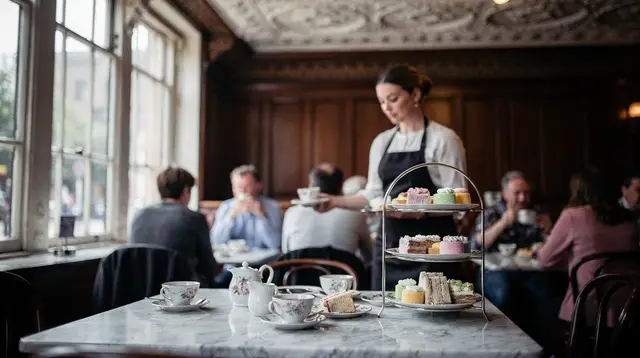
Afternoon tea — finger sandwiches, scones with clotted cream, a tiered stand, table service — is a distinct London tradition rather than a normal lunch option, and it’s priced accordingly at most hotels and dedicated tea rooms. Treat it as a one-off occasion during a trip rather than a meal you’ll want daily. Quality and value both vary widely between venues, so check recent reviews before booking rather than choosing by hotel name alone. Full comparisons are in the afternoon tea in London guide.
By neighbourhood
This guide covers London-wide patterns; for area-specific recommendations, use the neighbourhood pages:
- Westminster food and drink tours — pubs and cafes near the Palace and Abbey
- South Bank food and drink tours — Borough Market and riverside dining
- West End food and drink tours — pre-theatre dining and Soho
- Camden food and drink tours — market food and canal-side pubs
- East London food and drink tours — Brick Lane and Shoreditch
- Kensington-Chelsea food and drink tours — afternoon tea territory
For planning where food fits into a wider visit, see things to do in London and the London food markets and food tours guide for a market-by-market breakdown.
Frequently asked questions about food and drink in London
Is tipping mandatory in London restaurants?
No. Many restaurants add a discretionary service charge of around 12.5% to the bill, which you can ask to have removed if service was poor. If no charge is added and you were happy with the meal, 10-12.5% is standard. Pubs don’t expect tips for drinks at the bar.
Where are the tourist food traps in London?
Cafes and pubs directly facing major sights — around the Tower of London, Westminster Abbey, Buckingham Palace and Leicester Square — typically charge more for average food. Walking a few minutes into a residential side street usually finds better value.
What are the best food markets in London?
Borough Market near South Bank is the best known, with produce stalls and street food stands. Camden Market mixes food with crafts and clothing. Brick Lane in East London is known for bagels, curry houses and weekend street food stalls.
Do London pubs serve food all day?
Most pubs serve lunch and dinner during set kitchen hours, often stopping mid-afternoon and restarting in the evening. Historic pubs in the City and Westminster can get crowded after work on weekday evenings, so arrive early for a table.
Is afternoon tea in London worth the price?
Prices for a proper hotel afternoon tea usually run high, and quality varies. It is a specific experience — finger sandwiches, scones and tea service — rather than an everyday meal, so treat it as a one-off rather than routine dining.
Can I drink tap water in London restaurants and pubs?
Yes, tap water is safe everywhere in London and restaurants and pubs are required to provide it free on request, though some staff may not offer it unprompted.
Are food tours worth booking in London?
A guided food tour works well for a first visit, since it packs several tastings and some history into a couple of hours without you having to plan the route. For a longer stay, mixing one guided tour with independent market visits usually gives better value.
Do I need to book restaurants in advance in London?
For a casual pub meal or a market stall, no booking is needed — just turn up. For a specific well-reviewed restaurant, especially on a Friday or Saturday evening, book a few days ahead; popular spots in the West End and South Bank fill their evening slots well before the door, and walking in without a reservation often means a long wait or no table at all.
Is it safe to eat street food from London’s markets?
Yes. Stalls at Borough, Camden and Brick Lane operate under the same food hygiene rules as any London restaurant, and ratings are displayed if you look for them. The bigger risk to food quality is picking a stall purely because it’s the first one you see near the entrance, rather than one with a visible queue of regulars.
Food and drink tasting tours on GetYourGuide
Verified deep-linked GetYourGuide tours. Book through these links and we earn a small commission at no cost to you.
GetYourGuide does not provide a product photo for this activity — the image shows the meeting point, photographed by us.