London food markets and food tours
Are London's food markets and food tours worth the time and money?
Borough Market, Camden Market and Brick Lane are worth a couple of hours each for grazing, but they get crowded fast, so go early or late. A guided food tour (roughly £50-£100 per person for 2-3 hours) is worth it mainly for pairing tastings with context you would not get browsing stalls alone; skip cafes right outside major sights, since prices there are inflated for the footfall, not the food.
What to expect from London’s food scene
London’s food scene runs on two very different tracks. On one side are the historic markets and pubs that predate mass tourism by decades, if not centuries. On the other are the clusters of cafes and sandwich chains that have grown up directly outside major sights, priced for people who have twenty minutes between a ticket and a train. Knowing which is which saves both money and a wasted meal.
This page is a general orientation for the whole city. For the detail on any one neighbourhood — where the good stalls actually are inside Borough Market, or which Shoreditch street food vendors are worth queuing for — see the food and drink guides for Westminster, South Bank, Camden, East London, West End, Kensington-Chelsea and Tower/City, or the things to do in London hub for a wider view.
London’s main food markets
None of these markets are secret, and none need advance booking, but timing changes the experience.
| Market | Location | Best for | Best time to go |
|---|---|---|---|
| Borough Market | South Bank | Produce stalls, ready-to-eat food, cheese and bread | Weekday mornings, or after 3pm |
| Camden Market | Camden | Street food stalls, vintage stalls, canal-side food | Weekday afternoons |
| Brick Lane | East London | Bagels, curry houses, Sunday street food market | Sunday late morning |
| Columbia Road | East London | Flower market with cafes nearby (Sundays only) | Sunday morning |
| Old Spitalfields Market | East London | Covered market, mixed food and crafts | Weekday lunchtime |
Borough Market is the most useful stop for a general food introduction, since it is walkable from the Tower of London and Tate Modern and covers everything from oysters to pastries under one roof. It is also the most crowded market in London on a weekend, so a weekday visit or a late-afternoon pass through gives more room to actually taste things rather than queue for them.
Camden Market is larger and more spread out, mixing street food with clothing and craft stalls; expect to spend at least two hours if food is the goal, since the food stalls are scattered rather than grouped. Brick Lane and Columbia Road are East London’s Sunday combination — flowers at Columbia Road, then a walk down to Brick Lane for bagels and curry — but neither runs at full strength on other days of the week.
None of these markets require a ticket or a booking. What they do reward is arriving with a rough sense of what you want, since browsing every stall at Borough Market on a Saturday afternoon competing with a few thousand other visitors is not a relaxing way to eat lunch.
Pubs: what’s actually traditional and what isn’t
A London pub can mean several different things, and telling them apart matters more than most guides admit.
Historic pubs — buildings with genuine age, often 17th or 18th century, sometimes with literary or historical claims attached (a Dickens connection, a WWII story). These are worth a visit for atmosphere, though food quality varies and prices in central pubs run higher than the same meal a few streets away.
Gastropubs — pubs that have shifted toward a full restaurant menu, table service and higher prices. Food is usually the strongest reason to visit; the pub atmosphere is often secondary.
Chain pubs — recognisable branded pubs found near stations and busy streets. Reliable, inexpensive, unremarkable food, and a safe fallback rather than a highlight.
Local pubs — the ones without tourist coach parties, usually a short walk from a main street. These tend to have the most relaxed atmosphere and, often, the best value food, precisely because they aren’t optimised for passing footfall.
A pub crawl or history-themed pub walk works well paired with a wider look at East London’s darker history — see the Jack the Ripper and ghost tours guide for context on that specific angle, or the general pub culture guide for etiquette and ordering norms.
Avoiding tourist-trap cafes near major sights
This is the part most travel content skips. Cafes, sandwich bars and “traditional” tea rooms clustered within a five-minute walk of major sights — the Tower of London, Westminster Abbey, Buckingham Palace, the London Eye — are priced for convenience, not quality. A sandwich that costs £4 two streets over can cost £8-£9 right outside a ticket entrance, and the coffee is rarely better for the mark-up.
The honest rule: walk ten minutes further before eating anywhere directly outside a queue for a major attraction. Around Westminster, that means heading toward Victoria Street rather than staying on the stretch nearest the Abbey. Around the Tower of London, the City side has cheaper and often better options than the immediate riverside strip. Near South Bank, Borough Market itself is the better bet over the chain cafes directly on the river path.
The same logic applies to Oxford Street and Piccadilly Circus in the West End: the busiest corners have the highest prices for the least distinctive food, while a short walk into Soho’s side streets brings both variety and better value.
Food tours: what you’re actually paying for
A guided food tour (typically £50-£100 per person for 2-3 hours, though prices vary by group size and route, so check the current rate on the booking page rather than relying on a fixed figure here) gives you three things markets alone don’t: a fixed sequence of stops chosen in advance, a guide who explains what you’re eating and why, and tastings at spots that would be hard to identify or choose confidently on a first visit.
a guided walking food tour through central London’s markets and side streets covers several stops in one outing and suits a first-time visitor who wants a structured introduction rather than a self-guided wander.
For something more personal, a smaller-group tasting tour built around a specific theme or route trades scale for a slower pace and more one-on-one time with the guide.
Cuisines beyond the usual British staples are also covered: a Nigerian food tour through one of London’s West African food communities is a good example of the kind of specific, less obvious tour that a market visit alone would never surface.
For a broader single outing, a foodie walk covering ten different dishes and drinks across several stops works well for visitors who want variety over depth in one afternoon.
Whether a tour is worth it over independent exploring depends mostly on time and confidence: a two- or three-day visit benefits more from a structured tour, while a week-long stay has time to explore markets and pubs at a slower, cheaper, self-directed pace. Either way, book a tour date ahead rather than assuming a walk-up slot will be available, especially on weekends.
Tipping and service charges — what’s actually expected
Tipping in London is not automatic, and it is not calculated the way it is in some other countries. The single most useful habit: check the bill before adding anything, because many restaurants already add a 12.5% service charge as a line item. Adding a further tip on top of that charge is optional, not expected.
In pubs, there is generally no tipping expectation for drinks ordered and paid at the bar. For table service in a pub restaurant, the same service-charge check applies. In cafes and quick-service food stalls at markets, tipping is uncommon; a tip jar at the till is optional, never obligatory.
For a fuller breakdown of costs across the city beyond food — transport, attractions, accommodation — see money, tipping and costs in London and, for a tighter budget approach generally, London on a budget.
A realistic food day, by budget
| Budget | Breakfast | Lunch | Dinner |
|---|---|---|---|
| Tight | Bakery pastry, £2-£3 | Market stall plate, £8-£12 | Chain pub meal, £12-£15 |
| Moderate | Cafe breakfast, £8-£10 | Sit-down lunch, £15-£20 | Gastropub dinner, £20-£30 |
| Higher | Hotel or brunch spot, £15-£20 | Restaurant lunch, £25-£35 | Sit-down dinner, £35+ |
These are ranges, not fixed prices; menu prices shift by neighbourhood, and central zones (Westminster, West End, South Bank riverside) sit at the upper end of each range compared with East London or Camden.
Afternoon tea and other food traditions
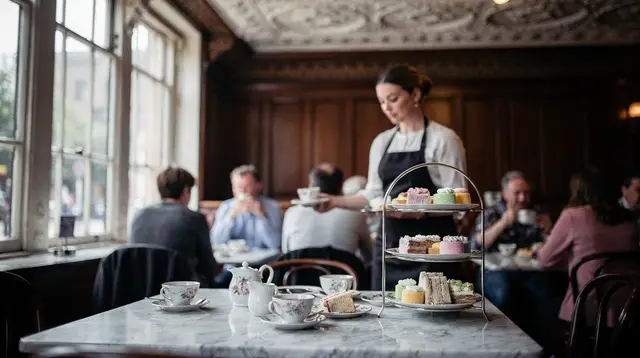
Afternoon tea deserves its own mention since it is neither a market stop nor a pub meal, and it is easy to overpay for a mediocre version. Prices range widely — roughly £35 at the simpler end to well over £80 at a well-known hotel — and the difference is mostly about setting and service rather than the food itself. The afternoon tea guide covers which versions are worth the higher price and which aren’t, and the London afternoon tea category page lists bookable options by area.
Fish and chips is the other tradition worth getting right rather than settling for the nearest tourist-facing shop. Quality varies enormously between a takeaway near a station and a proper chip shop a few streets away — worth checking a guide or asking locally rather than judging by proximity to a sight.
Christmas markets and seasonal food
Outside the main season, London runs seasonal food markets around Christmas — stalls selling mulled wine, roasted chestnuts and seasonal treats appear across the West End and South Bank from late November. a Christmas lights and markets walking tour through the West End’s seasonal stalls and light displays combines the festive market food with a guided route past the main light installations, which is a reasonable way to cover both in one evening rather than working it out street by street. See Christmas and New Year in London for the wider seasonal picture, or London Christmas seasonal for the full list of seasonal activities.
Where food overlaps with other themes
Food tours in London often bundle with other angles rather than standing alone. History-themed food and market walks appear in the east London ghost and crime tours guide territory as well — markets like Spitalfields sit inside the same East End streets associated with Jack the Ripper history, so a single afternoon can combine a market stop with darker historical context. a walking tour connecting East London’s market history with its true-crime past is one way to combine the two rather than booking separately.
For a wider view of the city that includes food stops among broader sightseeing, the central London bespoke walking tours category covers custom routes that can be built around food, history or both, and a private guide can usually adjust a standard route toward food-focused stops on request.
Quick answers before you go
The single most useful rule for food in London: distance from a major sight is inversely related to value. The cafe closest to the ticket gate is almost never the best option nearby. Markets reward arriving with a plan rather than browsing every stall. Pubs reward knowing which of the four rough categories you’re walking into. And on tipping, the bill itself tells you what’s already included — read it before deciding whether to add anything.
For planning the rest of a visit around food, pair this guide with free things to do in London for balancing a food budget against sightseeing costs, or where to stay in London if choosing a base near Borough Market, Camden or the West End for easier access to the food scene covered here.
Frequently asked questions about food and markets in London
Is tipping expected in London restaurants and pubs?
No fixed rule applies. Many restaurants add a 12.5% service charge to the bill automatically, so check before adding more. Pubs generally don’t expect a tip for drinks at the bar, though rounding up or leaving small change for table service is common.
Which London food market is best for a first visit?
Borough Market, near South Bank, is the most central and has the widest mix of produce stalls and ready-to-eat food. Go before midday or after 3pm to avoid the worst crowds; lunchtime on a weekend is the busiest window.
Are cafes near the Tower of London or Westminster good value?
Generally no. Cafes and sandwich shops within a few minutes’ walk of the Tower of London, Westminster Abbey or Buckingham Palace charge a premium for location, not quality. Walking ten minutes further usually finds better food at a lower price.
Do London pubs serve food all day?
Most pubs serve food at lunch (roughly midday-2:30pm) and dinner (around 6-9pm), with a gap in the afternoon at many traditional pubs. Gastropubs and chain pubs are more likely to serve food continuously.
Is a London food tour better than visiting markets alone?
A food tour adds context, a fixed itinerary and often a few tastings you would not find on your own, which suits a first visit or a short stay. Visiting markets independently costs less and lets you linger, which suits a longer stay or a repeat visitor.
What is a fair price for a sit-down lunch in central London?
A casual sit-down lunch (main course plus a drink) in zones 1-2 typically runs £15-£25 per person. Market stalls and food halls are usually cheaper, around £8-£15 for a full plate.
Food and drink tasting tours on GetYourGuide
Verified deep-linked GetYourGuide tours. Book through these links and we earn a small commission at no cost to you.
GetYourGuide does not provide a product photo for this activity — the image shows the meeting point, photographed by us.